

This List Will Change How You Feel About Snakes
Snakes are beautiful and mysterious animals who have an unearned negative reputation. Some people have even come to fear these stunning animals, but they have more reasons to fear us than we do to fear them.
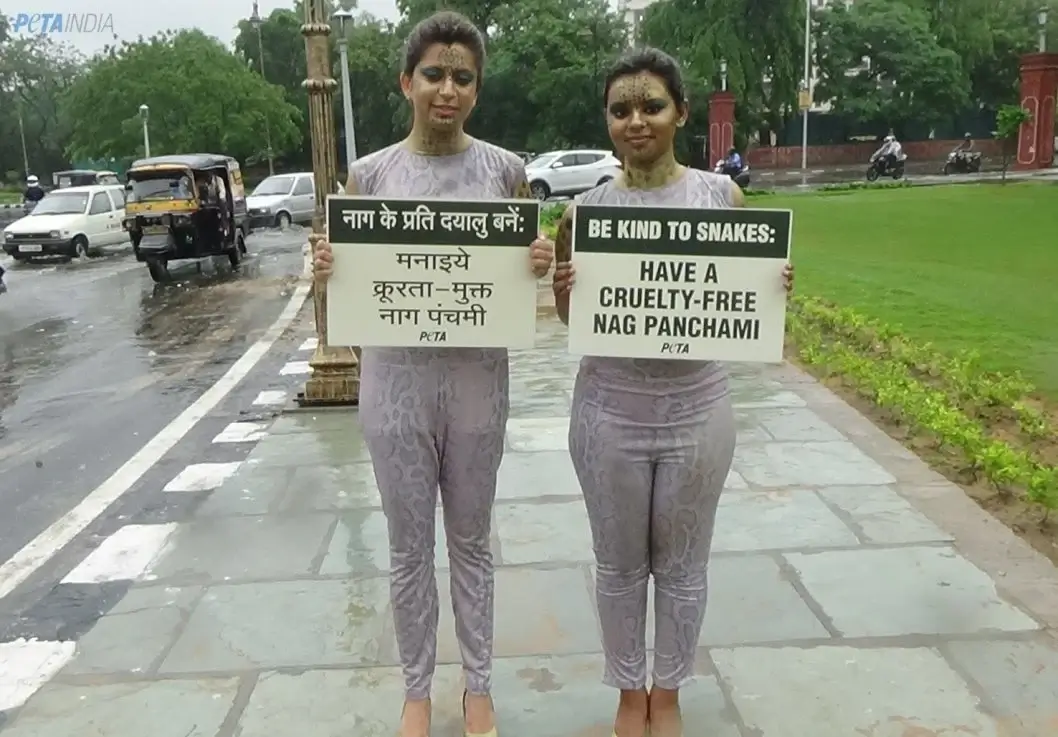
In India, snakes used for performances are captured in suffocating bags, kept in tiny boxes and starved. Their teeth are violently yanked out, and many snakes’ mouths are painfully sewn shut before the animals are brought into cities. The snakes’ venom ducts are often pierced with a hot needle, which causes the glands to burst. Some snakes go blind because the “tikka”, which is applied to their hoods during pooja, trickles into the snakes’ eyes. According to the Wildlife Protection Act 1972, it is a crime for snake charmers to catch snakes, exploit them for business purposes or even own them.
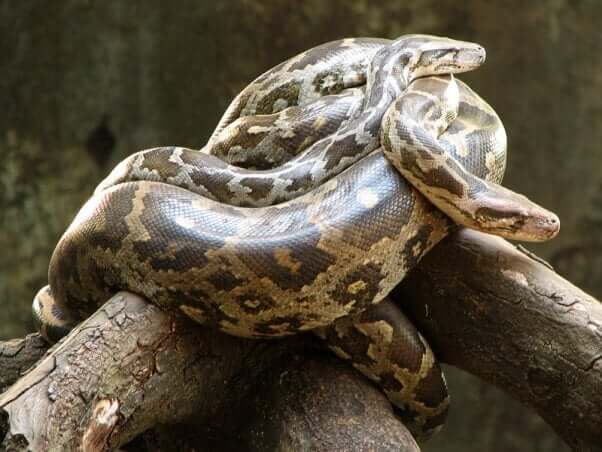
Every year, millions of pythons are slaughtered in Indonesia, Malaysia, and Vietnam just to be made into frivolous fashion accessories and thousands are illegally traded who are exported annually.
Most are torn from their own homes, often hunted down deep in the jungles of Indonesia and Malaysia.
Check out our list of snake facts and see how much you know about these amazing animals!
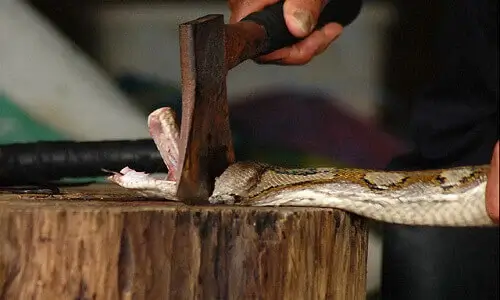
Once they are captured, their heads are often forced down and severed with a machete. Others have their heads nailed to a tree and their skins slowly peeled off. Because of their slow metabolisms, snakes remain conscious and able to feel pain and fear long after they are decapitated.
If they aren’t beheaded or nailed to a tree, they are bludgeoned and beaten. Their jaws are forced open so that a tube can be jammed down their throats in order to pump their bodies full of water and make the skins easier to remove. Ropes are tied tightly around their necks to prevent any fluids from escaping their bodies.
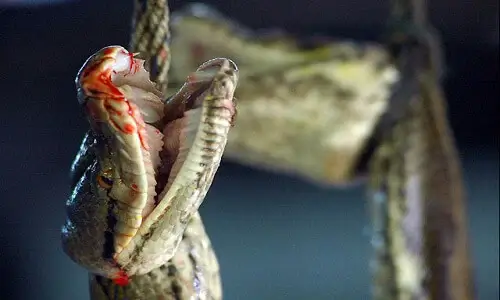
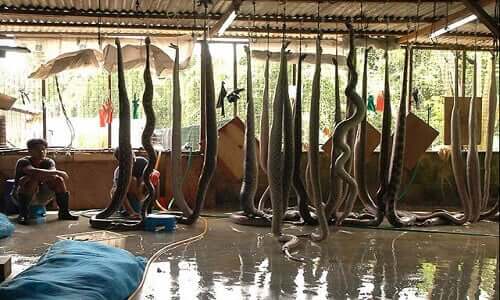
Bloated, suffering, and dying slowly, they can be left hanging for more than 10 minutes.
Their bodies are slit open from end to end to loosen their once strong and protective skin.
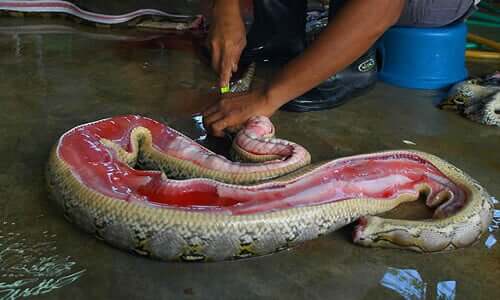
Once the skin is limp, it is ripped from the snakes’ bodies. The snakes’ skins are no longer their own and are now the prized possession of their captors. The skins are shipped off to tanneries to be finished and sold to the fashion industry.
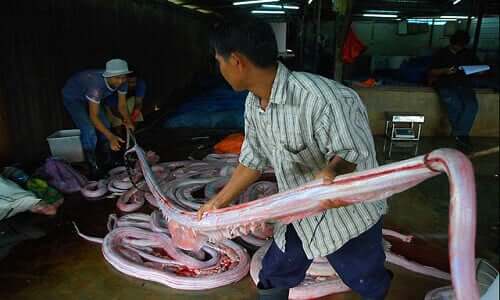
Because of the techniques used by bloody-handed hunters, many snakes are still alive as they are tossed into a pile of their own kind and left to die slowly. Their lives no longer have meaning to their captors, and they often suffer for several days before dying from dehydration.
Snakes are not the only animals who suffer for fashion. Millions of lizards, alligators, crocodiles, and other reptiles are violently killed every year so that their skins can be torn from their bodies to make wallets, belts, boots, and handbags. Reptiles may be cold-blooded, but wearing their skins is cold-hearted. Please don’t support this suffering. Never buy anything made of the skin of animals.
Today, eco-friendly vegan leather produced in India includes leather made from plants such as sugarcane bagasse and mango pulp. The “PETA-Approved Vegan” certification authenticates handbags, shoes, clothing, accessories, furniture, and home decor items made from vegan materials rather than animal-derived ones. Over 1000 companies worldwide are using the “PETA-Approved Vegan” logo to enable socially conscious consumers in India and elsewhere to identify vegan products at a glance while shopping.
Browse Cruelty-Free Brands Here