
Written by PETA
Right before the High Court of Bombay hearing for Mumbai's horse-drawn carriages on 13 December 2012, PETA released the findings of its latest investigation of cruelty to horses used by the carriage industry in the city.
See some of the heart-rending photographs from PETA's investigation, which show sick, injured, overworked and malnourished horses forced to live in atrociously filthy conditions.
An earlier court ruling suggested that horses found to be unfit should not be used for pulling carriages again until a veterinary officer determines that they are fit. As PETA points out, though, the stables are in decrepit condition, and forcing horses to work in the congested city, hauling loads on pavement, deteriorates their physical and mental health. The following are just a few of PETA's findings:
Join the campaign and call for a ban on cruel horse-drawn carriages in Mumbai.
Representing PETA India and Animal Rahat, a panel of India's most renowned equine veterinarians – who together have more than 32 years of experience addressing India's most challenging equine welfare issues – came together with Mumbai for Horses and People for Animals to make the case that the only way to stop the abuse and suffering of horses used to pull carriages through the streets of Mumbai and avoid the traffic hazards that they cause is to enact an all-out city-wide ban on Victorias. The experts also explained that passengers, drivers and pedestrians are injured and even killed when horse-drawn carriages are involved in accidents.
Three equine experts – Dr Manilal Valliyate, director of veterinary affairs for PETA India and member of the Animal Welfare Board of India; Dr Avinash Kumar, a leading equine veterinarian who has worked for The Brooke, an equine welfare charity; and Dr Chetan Yadav, an equine veterinarian and leading animal welfare specialist working for Animal Rahat – presented graphic, never-before-seen photos and video footage proving that keeping horse-drawn carriages on the roads would only ensure that the cycle of abuse continues.
Dr Valliyate explained that once horses lose function in a joint, as happens quickly when they're made to walk on pavement or haul heavy loads, more stress will be placed on their other joints, tendons and ligaments. No veterinary medicine or surgery can cure this condition, and it cannot be reversed. The equine veterinarians also pointed out that any move to issue licenses to the city's currently filthy, decrepit and illegal stables could subject the horses to various infectious diseases – such as glanders, strangles, tetanus and equine influenza – and cause many animals to die.
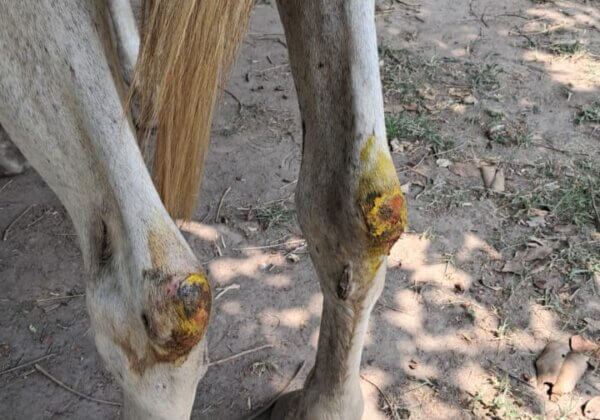
Horse used to haul a carriage despite painfully swollen joints.
Furthermore, despite an order from the Bombay High Court that nongovernmental organisations be permitted to inspect horses for signs of poor health or compromised welfare and report the matter to an executive health officer and despite holding written authorisation from the Animal Welfare Board of India – a statutory body under the Ministry of Environment and Forests – to conduct such an inspection, a team of equine veterinarians from PETA and Animal Rahat was harassed and prevented from conducting inspections of the horses used to haul carriages in Mumbai by the carriage owners and drivers and their lawyer.
On behalf of PETA India, Jism 2 writer Mahesh Bhatt; director Pooja Bhatt; lyric writer, music producer and background score composer Munish Makhija; co-producer Dino Morea; actors Sunny Leone and Arunoday Singh; and music director Arko Pravo Mukerjee have fired off an urgent letter to Prithviraj Chavan, the chief minister of Maharashtra, urging him to immediately ban the use of horse-drawn carriages in Mumbai.
In the letter,the Jism 2 team points out that the horses are forced to haul heavy loads and are driven beyond their capacity to the point of collapse. The team also explains that passengers, drivers and pedestrians are injured and sometimes killed when the carriages and horses are involved in accidents.
"Forcing horses to haul carriages in Mumbai is inherently cruel, as the horses routinely collapse from exhaustion", reads the letter. "They're also a traffic nuisance, and people have even died from accidents caused by horse-drawn carriages. It is high time to put horse carriages out to pasture – for good."
The letter also explains that the Bombay High Court's order to have non-governmental organisations bring ill and injured horses to the executive health officer's notice and that the horses be given veterinary care before being pressed back into service is woefully inadequate. That's because the horses will be forced to resume pulling heavy loads, only to fall ill or get injured again, and the cycle of suffering will continue. However, recently, it's been shown that despite this order, inspections are not even being permitted. A team consisting of equine veterinarians from PETA India and Animal Rahat were harassed and stopped from conducting inspections of the horses used to haul carriages in Mumbai by the horse-carriage owners and drivers and their lawyer, despite holding written authorisation from the Animal Welfare Board of India, a statutory body under the Ministry of Environment and Forests, to conduct the inspection.
Please help urge the authorities to ban horse-drawn carriages by taking action now.