
Written by PETA
It's time to Dishoom! exotic leather sellers. Joaquin Phoenix stars in an exclusive new video to get consumers to shed animal skins from their wardrobes by showing what happens to alligators, lizards and snakes before they are made into belts, bags and shoes.Fashion is a style statement and why shouldn’t it be? Who doesn’t want to look hip and cool? But fashion should be fun, not fatal. There’s nothing fun about exotic animals being raised and killed specifically for exotic leather accessories that cost animals their lives but which we wear once or twice to a party. Most people have no idea that snakes are often nailed by their heads to trees, and their bodies are cut open from one end to the other before they are skinned alive. Their heads writhe for several minutes after they are severed, and their hearts beat for up to 40 minutes after they have been removed. Alligators are often clubbed to death on filthy factory farms until they stop moving and die.Still not convinced that you should stop buying leather. Watch the video below.
Please help us Dishoom! leather sellers by pledging to quit wearing exotic skins. Want to do more to help? Join our Street Team to get the most up-to-date information on how you can help animals.
During the past 10 years, PETA India has organized innumerable eye-catching demonstrations to call attention to cruelty to animals and teach people about what they can do to lessen animal suffering. PETA's no-holds-barred, street theatre–style demonstrations not only reach passers-by but also garner loads of media coverage. As a result, millions of people learn about our campaigns. Throughout the years, our protests have been covered by countless newspapers – including The Times of India, The Asian Age, the Daily News and Analysis, the Hindustan Times and the Sakaal Times – enabling us to reach people from all walks of life.
We've achieved many victories as a result of our colourful demonstrations and other creative attempts to raise awareness. The following demonstrations are 10 of our most memorable:
1. PETA holds a funeral procession to mourn all the animals killed in cosmetics tests.
2. Club-wielding "cavepeople" claim the Ministry of Health is stuck in the Stone Age and demand cruelty-free personal-care products.
3. Our heavenly "angel" urges Kolkata residents to adopt Indian community dogs.
4. A well-dressed PETA member carrying the "bloody" head of a "cow" on a meat hook asks Kolkata residents, "Did your shoes have a face? Go leather-free".
5. An activist in a full-length dress made of lettuce tells Mumbai residents, "Let veganism grow on you".
6. A crippled "chicken" in a wheelchair warns Bangaloreans that "KFC terrorises chickens".
7. An injured "bird" squawks about glass-coated manja and asks Gujaratis to cut out cruelty.
8. PETA members reveal the naked truth about the flesh trade.
9. PETA's "angel of death" whips a "bullock" who pulls a kerosene tank cart.
10. A giant "polar bear" who is crushed by a "shoe" urges shoppers to put the freeze on leather.
I don’t know about you, but I’ve never seen a bear out dancing at the club. After all, bears weren’t made to dance. Sadly, that’s exactly what they were made to do across the country. Speaking of bears, check out this warm and fuzzy PETA India victory:
In 2003, PETA India helped rescue six bears who were being forced to beg and perform tricks on the streets of Mumbai. With no protection from the sun, all of the bears were found with ropes forced through their noses. The bears were taken to a rescue centre outside Agra. PETA India was also instrumental in rescuing five more bears from madaris and taking the animals to rehabilitation centres.
“Dancing" bears were a common – but tragic – sight in India. Even though it has been illegal to capture bears since 1972, this law was blatantly ignored, and madaris made bears dance for up to 12 hours a day. When the bears are just 1 year old, cubs had their canine teeth knocked out and ropes forced through their noses without any painkillers. During this process, the cub was held down while a red-hot needle is forced through the squealing animal's nose. A rope was then shoved into the piercing, which usually becomes infected.
When the ropes attached to the traumatised bears were tugged, the animals lifted their legs and "dance". Bears were trained through a regime of pain and starvation, and they rarely survived more than eight years – a third of their natural life expectancy.
No animal should have to “bear” this type of abuse. Never patronize a roadside animal show, whether they use bears, monkeys or snakes. If you see tourists encouraging such a show, speak to them about the cruelty. In 2009, it was reported that India's last dancing bear was rescued from a life of neglect and . If, however, you still see any madari with a bear, report him to the closest police station.
After you finish school every day, are you greeted by a bunch of cute, loving dogs? Twelve-year-old New Delhi student Laura Moll is! Originally from Germany, Moll says that she has always loved animals. Sound familiar?
Moll is an aspiring veterinarian, and she volunteers at Friendicoes Society for the Eradication of Cruelty to Animals (SECA), a local homeless animal shelter. She records her efforts to help animals on her moving website lamo-india.de. Moll also uses the site – which features poignant photographs of the many homeless animals who have touched her heart – to encourage the public to adopt homeless animals. Moll's dedication to helping animals is a wonderful example for compassionate people everywhere to follow. You can help animals too. If you see injured animals or animals in distress, never give up trying to help them. Take animals who are in need of help to a nearby animal shelter or veterinary clinic. Remember, animals have no voice and need you to speak up for them.
We don't care if your favourite animal is a chicken, a dog or an elephant – you can always join our Street Team and make a difference for animals, just like Laura did!
If our recent blog about Happy the crane made you happy, you’re going to love this PETA India victory:
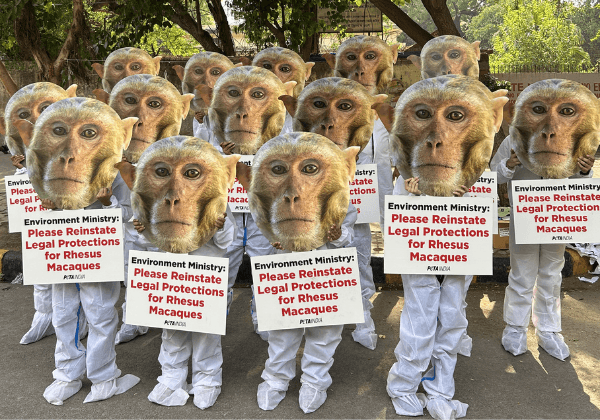
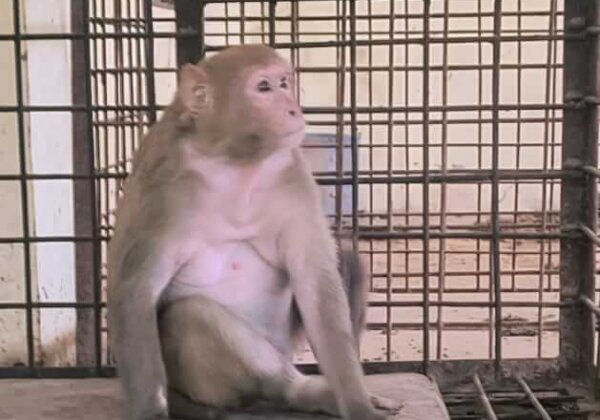
Pardon the obvious pun (I can’t help myself), but when it comes to bustin’ big, bad animal experimenters — PETA India doesn’t ‘monkey’ around. Seriously. Back in 2002, PETA and the Committee for the Purpose of Control and Supervision of Experiments on Animals (CPCSEA) busted Pune’s National Institute of Virology (NIV) for making animals suffer in nightmarish conditions.
During a visit to the facility, investigators discovered a monkey named Paro and many other animals crammed into dank, dark, filthy cages encrusted with urine and faeces. Goats and sheep were unable to walk due to overgrown hooves. Many of the monkeys were suffering from skin lacerations and severed digits, most likely caused by years of clawing futilely at their cages. Which isn’t surprising when you take into consideration that most of the monkeys had been imprisoned at NIV for more than a decade! Can you imagine spending more than 10 years locked in a tiny, barren cell — every day filled with abuse, deprivation, isolation and misery?
Here’s the good news: based on these findings, Paro and nearly 40 of his friends were rescued and taken to a rehabilitation facility in Pune. Here’s even better news: you have the power to help animals still incarcerated in laboratories by taking a stand against The All India Institute of Medical Sciences (AIIMS), a facility that is currently physically and psychologically tormenting hundreds of animals behind closed doors. C’mon, let’s make Paro proud!
As we continue to take a walk down memory lane and revisit some of PETA India’s biggest and bestest victories, we came across this very “happy” story:
Picture this: It’s 2001 at the notoriously dismal and poorly maintained Prince of Wales Zoo in Lucknow. Officials at the zoo announce that they want to keep a baby crane named Happy imprisoned for ‘entertainment’ instead of granting her the freedom that she deserves (it’s pretty obvious that birds are meant to fly free . Hearing this oh-so-animal-unfriendly news, PETA India immediately flew to the rescue. After posting an action alert on its Web site that garnered more than 1,000 petition signatures from Tamil schoolchildren and prompted tonnes of telephone calls, letters and e-mails from people all around the world, the zoo decided to set Happy free!
Okay, now picture this: It’s 2010, and thousands of animals are still behind bars at zoos across the country. The animals may have changed over the years, but the conditions have stayed the same. PETA India has conducted an investigation of more than 30 zoos across the country and found appalling neglect, decrepit facilities, and animal suffering on a massive scale. Many live in concrete and iron cages without even a blade of grass to remind them of their natural habitats. Between cramped, barren enclosures, poor nutrition, and mind-numbing monotony, it’s no wonder that many go crazy and spend hour after hour, day after day, pacing, bobbing their heads, gnawing at the bars, and doing other destructive and abnormal behaviours.
Speaking of behaviour, it goes without saying that you won’t be visiting a zoo again, right? You can however visit here to join our Street Team and earn cool prizes for giving zoos some good old-fashioned Dishoom!
We’re all about Kellshoom! Who is Kellshoom you ask? Kellan Lutz + petaDishoom = Kellshoom. Get it?
That’s right, gorgeous Twilight saga actor Kellan Lutz—known to many fans as the studly vampire Emmett Cullen—reveals his softer side in a new ad for PETA. Part of the "Adopt, Don't Buy" campaign, the ad shows Lutz hugging his rescued mixed-breed dog Kola and reads, "Buying Animals Denies Needy Animals a Home”.
"I love mutts!" gushed Lutz. "If anything, I think mutts stay the healthiest." Lutz also addressed the animal-overpopulation crisis. "There are surprisingly so many animals in these animal shelters," he said. "It's sad, and knowing that there are not enough good homes for them … and there's a lot you can do … spay or neuter your pets so that doesn't happen."
We couldn’t agree more. Almost 25 million homeless dogs are languishing on the street in India because there aren't enough good homes and countless others in shelters. Buying an animal from a pet store or breeder robs a homeless animal of a chance at adoption and encourages sellers to acquire more animals. So if you're thinking about bringing an animal into your home—always adopt and never buy.
A big fan of mutts, Lutz encourages “Twilighters" to do just that and tells PETA, “Kola is my best friend." Check out Kellan's exclusive interview for PETA US and watch him share his thoughts about meeting Kola for the first time. Plus, listen as he gives Twilighters a special message letting them know what they can do to help animals!
In honour of PETA India's 10th anniversary, which we celebrated in December with a party packed full of some of the hottest celebs in Bollywood and beyond, we’re taking a look back at some of the many awesome achievements we’ve scored over the past 10 years. The following is the first in a series of blogs celebrating these victories: So how did PETA India begin? Sit back and read on…In 1999, after receiving complaints about the way animals used for leather were being treated, PETA founder Ingrid E. Newkirk put together a team and plunged head-on into an investigation of the Indian leather industry. What they found was shocking.
We're talking about abuse and behavior that clearly violated Indian law. PETA peeps actually witnessed guards being bribed to allow skin-traders to smuggle cattle across state borders! Cattle were being marched to their deaths over hundreds of miles - without any food and water. When they faltered or collapsed, men smeared chili peppers and tobacco into their eyes and twisted their tails to keep them moving. Crammed into over-crowded transport trucks, many were trampled or gored to death during the long journey. By the time they arrived at the slaughterhouse, many had to be dragged inside. Once inside, their throats were slit in full view of others awaiting the same gruesome fate. Can you say illegal?
While the Constitution of India clearly prohibits cruelty to animals, the law, to this day, is still being violated while authorities simply look the other way. Needless to say, this investigation blew the lid off of the leather industry and prompted PETA to promptly found PETA India. The rest is history. And since that initial investigation, PETA India has been fighting hard to make the Indian leather industry history. And it's paid off—big time.
Within the first year, an international boycott, protests at Indian embassies around the world and letters from Sir Paul McCartney, Arun Gandhi, Jackie Chan, and other famous folks got tonnes of public attention, and forced officials to take notice. Then Prime Minister Shri Atal Behari Vajpayee directed state governments to enforce India's animal protection laws, and the minister of commerce and industry, publicly urged state governments to set up committees to ensure enforcement of the Prevention of Cruelty to Animals Act (PCA), 1960, promising that “surprise inspections of places where cattle are sold and loaded onto trucks” would be conducted.
to our investigations, Adidas, Gucci, Gap, Liz Claiborne, Kenneth Cole and about 40 other leather retailers around the world decided to boycott leather from cruelly treated Indian animals. Top fashion designers, including Stella McCartney, Marc Bouwer, Hemant Trevedi, and Anita Dongre, also refuse to work with leather and offer stylish substitutes instead. After all, fashion should be fun, not fatal! Fortunately, it’s easier than ever to find products made of cotton, jute, plastic and pleather. Plus, many stores and nearly all major brands of shoes, including Bata, Reebok, Nike, Adidas, Liberty, offer non-leather alternatives. There is no excuse to wear the skins of any animal. Now is the perfect time to make some history of your own by giving leather the boot! From this day forward, pledge that the only skin that you will wear will be your own.