|
 |
Home > media
centre > News Releases >
FESTIVE ISSUE OF PETA’S ANIMAL TIMES MIXES HOT STARS WITH HOT
TIPS, RESCUES WITH RECIPES
Article on the ‘Dark Side’ of Dairy Industry Could Make
You Ditch the Dahi
For Immediate Release:
20 October 2003
Contact:
Bijal Vachharajani (0) 98201 22602; BijalV@petaindia.org
Mumbai – Want to learn why keeping the curd off your plate helps
cows and buffaloes and protects your own health, too? And how does soapstone
and hydrogen peroxide get into a glass of milk? The place to turn for
answers to these and other animal-related questions is the Festive 2003
issue of PETA’s Animal Times, which features everything
from hard-hitting exposés and healthy diet advice to celebrity
news and heroic animal-rescue stories.
One of PETA’s Animal Times’ most popular features
is the ‘Purrs & Grrrs’ section, which lets readers know
who’s cool and who’s cruel. In this issue:
• ‘Purrs’ go to customs officials
at Mumbai International Airport for confiscating four small antelopes
– who were suffering from gruesome injuries, shock and dehydration
after being illegally shipped in a claustrophobic crate – and
turning them over to PETA.
• ‘Grrrs’ are in order for Lubna Adams for directing
the Chennai International Leather Fair after designer Hemant Trevedi
stepped down because he couldn’t support the leather industry’s
shocking cruelty to animals.
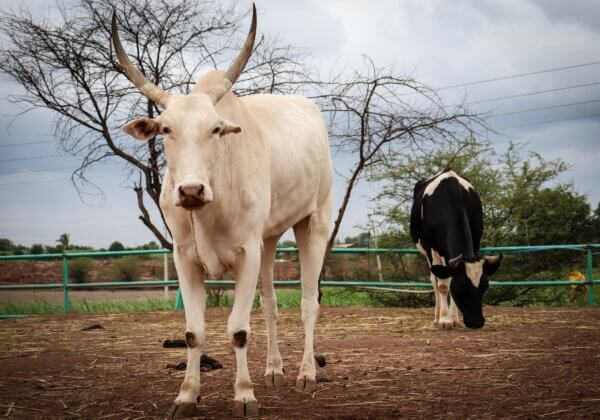
The magazine also contains a special report on the dairy industry,
‘The Dark Side of Dairy’, in which PETA reveals how cattle,
who were once revered in Hindu culture, now endure dreadful lives and
deaths at the hands of unscrupulous dairy farmers and the leather suppliers
anxious to tan their hides. Today’s ‘factory-farmed’
cows are impregnated and milked over and over, until they are too worn-out
to produce any more milk. Then, most are carried off to illegal abattoirs.
It is to India’s shame that male calves are now called ‘katra’
– one who is to be killed – because they are abandoned to
starve or killed right after birth. In Mumbai alone, 80,000 calves are
slaughtered every year.
PETA reports that consuming the milk meant for baby cows puts humans
at risk for a host of ailments, including cardiovascular disease; ovarian,
breast and prostate cancer; diabetes and even osteoporosis. Cow’s
milk is often contaminated with hydrogen peroxide, the cancer-causing
chemical zentamycin, Oxytocin – an illegal drug that farmers believe
increases milk production – and even crushed soapstone, which
is used to ‘increase’ skimmed-milk powder. The Consumer
Guidance Society of India found that high quantities of aflatoxins,
antibiotics, agro-chemical residues, pus, spore-forming bacteria and
chemicals like sodium carbonate and urea have been found in cow’s
milk. The study indicates that these contaminants have been linked to
liver cancer, gastro-enteritis, viral fever and weight loss.
In his column ‘Doctor in the House’, Dr Neal Barnard, president
of the Physicians Committee for Responsible Medicine (PCRM), explains
that some people may suffer potentially life-threatening reactions to
animal products. According to Dr Barnard, people who are allergic to
animal products may experience dermatitis, fever, blisters, bronchitis,
fatigue, irritability, tension, muscle or joint pain, nausea and other
gastrointestinal disorders and, in some cases, anaphylactic shock. Studies
have shown that diets high in dairy products and meat are associated
with more asthma attacks than are vegan diets.
Kids and adults alike will love the heart-warming story of a boy who
frees two fish whom his father had caught on a camping trip. ‘My
bathtub-size tank was a far cry from home for my fish’, writes
young Rahul Patil. ‘I thought how I would feel if I was kept in
a tank, away from my home’.
PETA’s Animal Times also lets readers know how they can
get involved in helping animals all over the country. All they have
to do is look for the ‘You Can Help’ segment at the end
of each article, which instructs animal-friendly people on what to do
and whom to contact when they spot cruelty to animals.
Says PETA Special Project Coordinator Bijal Vachharajani, ‘PETA’s
Animal Times is always in demand, because it gives readers the
information and encouragement that they need to act for animals in their
daily lives. After all, good intentions aren’t enough –
people need to convert words into deeds, and PETA’s Animal
Times tells them how’.
For information about becoming a PETA member and getting a yearly subscription
to PETA’s Animal Times, call (022) 2628 1880 or write
to PO Box 28260, Juhu, Mumbai 400 049.
PETA’s Animal Times is not copyrighted. Full
or partial reprints are encouraged. For high-quality copies of any of
the images, please contact
PETA.
|
 |
|

|