

India’s Monkeys Threatened by Foreign Animal Experimenters: PETA India Urges Prime Minister Modi to Reinstate Protection Taken From Rhesus Macaque Monkeys by Latest Wildlife Law Amendment
For Immediate Release:
17 July 2023
Contact:
Dr Ankita Pandey; [email protected]
Hiraj Laljani; [email protected]
Delhi – Following the recent removal of protection that had been afforded to rhesus macaque monkeys over the past 50 years under the Wildlife Protection Act (WPA), 1972, through the passage of The Wild Life (Protection) Amendment Act, 2022, People for the Ethical Treatment of Animals (PETA) India has written to Prime Minister Narendra Modi urging him to reinstate and strengthen protections for these vulnerable monkeys in order to safeguard animal welfare, local ecosystems, and human health. In the letter, PETA India raises the concern that these Earthly representatives of Lord Hanuman – whose population declined by 90% during the 1960s and ’70s, when they had fewer protections – are now at risk of being captured or killed for experimentation, meat, or the pet trade, among other abuses.
The copy of PETA India’s letter to Modi is available upon request.
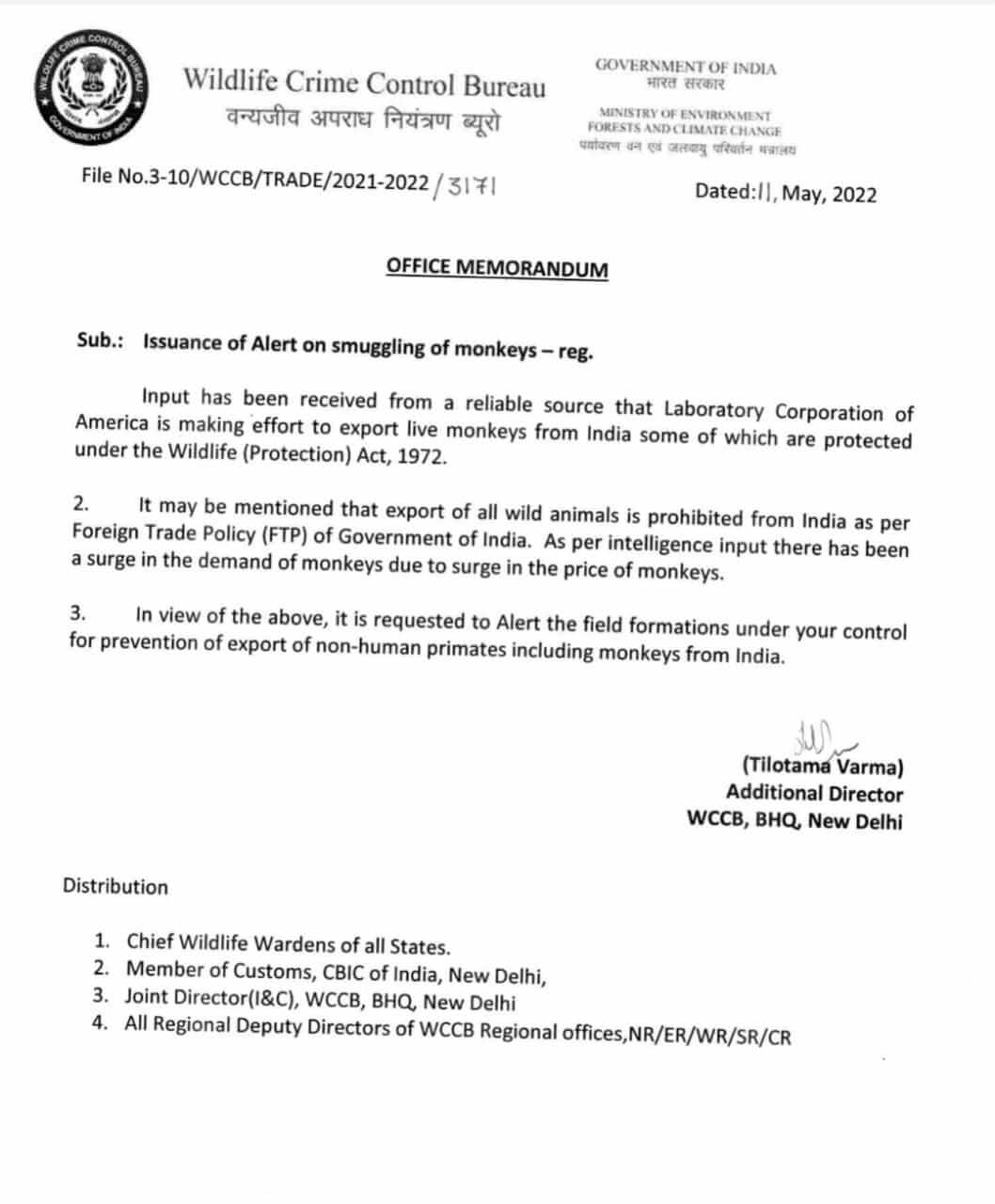
In the letter, PETA India warns of evidence that unscrupulous foreign monkey importers are hoping to pillage India’s rhesus macaque population. An office memorandum published by the Wildlife Crime Control Bureau (WCCB) on 11 May 2022 highlights possible attempts by the Laboratory Corporation of America to export vulnerable live monkeys from India. In response, the WCCB alerted its field formations to the situation in order to prevent the illegal export of non-human primates from India. This move reveals that Indian rhesus macaques face an imminent threat.
“Removing rhesus macaques from the Wildlife Protection Act through the 2022 amendment makes them vulnerable to capture, abuse, and exploitation,” says PETA India scientist Dr Ankita Pandey. “PETA India is urging the prime minister to spare these monkeys suffering and death by directing the ministry to grant them the highest protection that is afforded to numerous other indigenous species.”
In addition to being revered in Hinduism, rhesus macaques fulfil an important role in local ecosystems by dispersing seeds – due to their mostly fruit-based diet – and their absence can be detrimental to forests. Monkeys taken from their natural habitats by international wildlife dealers are often crammed into small wooden crates and transported in dark, terrifying cargo holds of planes for as long as 30 hours. The stress of capture and transportation can weaken their immune systems and risks the spread of zoonotic diseases in India and around the world. In laboratories, monkeys are typically confined alone to small metal cages and tormented in experiments in which they’re cut open, poisoned, crippled, addicted to drugs, electroshocked, and killed.
PETA India is urging Modi to consider these concerns, reinstate rhesus macaques as a protected species under the WPA, and grant them the highest protection afforded to numerous other indigenous species under Schedule I.
PETA India – whose motto reads, in part, that “animals are not ours to experiment on or abuse in any other way” – opposes speciesism, a human-supremacist worldview. For more information, please visit PETAIndia.com or follow the group on Twitter, Facebook, or Instagram.
#