

Victory! CT University Ends Forced Swim Test and Commits to Modern Research Methods
After hearing from PETA India about the cruelty and scientific invalidity of the forced swim test (FST), CT University will “formally adopt a policy prohibiting the use of FST in all current and future research”.
This follows PETA India’s first institutional victory against the experiment at Chitkara University in Chandigarh, which confirmed that it would no longer conduct the forced swim test after hearing from PETA India.
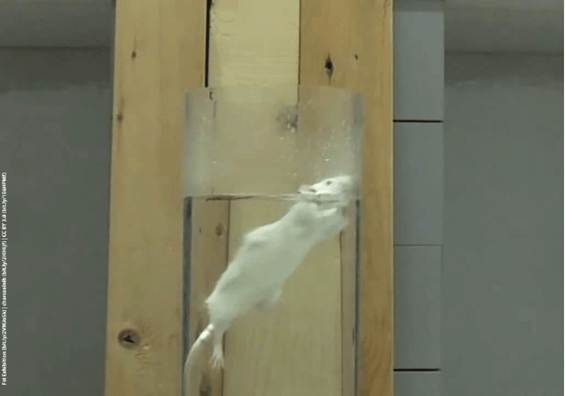
Credit:Fst Exhibition (bit.ly/2VMJoSk) | charcoalnih (bit.ly/2HlHijf) | CC BY 3.0 (bit.ly/1E6HPMf)
In the FST, mice, hamsters, and other small animals are dosed with test substances, placed in inescapable beakers filled with water, and made to swim to keep from drowning – purportedly to shed light on human depression. The experiment has been heavily criticized by scientists who argue that the animals giving up and floating is not a sign of depression or despair, but rather an indicator that the animals are simply saving energy and adapting to a new environment. Research suggests the test may even be less reliable than a coin toss to determine the effectiveness of antidepressant medications.
In an email to PETA India, CT University Principal Dr. Vir Vikram also confirmed that CT University recognizes
“that immobility in FST is often a learned, adaptive behavior rather than a valid model for human depression”, adding: “Our School of Pharmaceutical Sciences will prioritize human-relevant models, including computational modeling, in vitro human cell studies, Alternatives to animal studies, and genomics.”
Following a push from PETA India, the Pharmacy Council of India in April directed all agencies under its purview – including CT University – to review and take necessary action on the continued use of the widely debunked experiment. More than 100 scientists and scientific experts have also joined PETA India’s call urging regulators and institutions to end the use of the forced swim test.
Other government agencies, universities, and pharmaceutical companies around the world have pledged not to permit, conduct, or fund the FST after hearing from PETA entities. PETA India is intensifying efforts to urge the Committee for Control and Supervision of Experiments on Animals (CCSEA) to ban the cruel experiment at the national level.
Support Our Efforts