

Man Jailed Over Disturbing Wildlife Hunting and Killing Videos in Unnao, Following PETA India Complaint
After learning of several disturbing videos published on Facebook and Instagram by an individual named Mobeen Khan showing him hunting, tormenting and killing birds and other wild animals protected under Schedules I and II of the Wild Life (Protection) Act (WPA), 1972, PETA India worked with the Unnao Forest Division, particularly the Divisional Forest Officer Unnao, Smt Arushi Mishra, IFS and the Unnao Police to get a First Information Report (FIR) and a wildlife complaint registered against him. He was arrested, produced before the court, and sent to judicial custody.
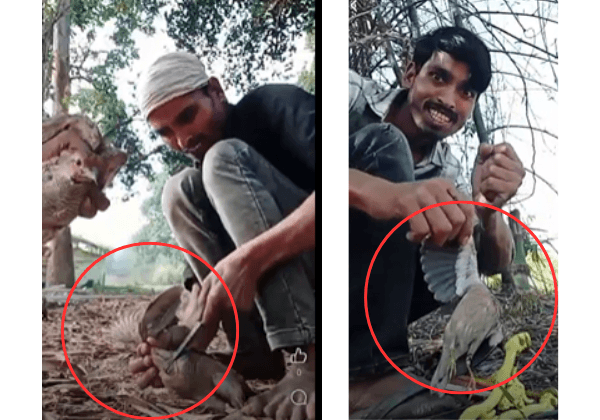
In the videos, the accused is seen capturing wild animals and birds using a slingshot, tormenting and killing them for social media likes. Many of the species hunted are those protected under Schedule I of the WPA, including Spectacled Indian cobra, Peacocks and Bengal monitor lizard, as well as species protected under Schedule II, including Common Wolf Snake, Black kite, Rock Bush Quail, White-breasted Waterhen, White throated Kingfisher, Jungle babblers, Green Bee Eaters, Red whiskered Bulbul, Rose ringed Parakeets, Javan Myna and Common Moorhen.
Based on a complaint submitted by PETA India, the Unnao Forest Division submitted a complaint to the Fatehpur Chaurasi police station, which registered an FIR against the accused under Section 325 of the BNS and Section 11 of the PCA Act 1960. Additionally, the Unnao Forest Division filed a wildlife complaint directly before the Hon’ble Magistrate Court under Sections 9 and 51 of the WPA. Offences involving species protected under Schedule I are punishable with imprisonment of at least three years, which may extend to seven years, and a fine of at least ₹25,000; while offences involving species protected under Schedule II are punishable by a jail term of up to three years, or a fine of up to Rs 1 lakh, or both.
In addition to jail time, PETA India recommends that perpetrators of animal abuse undergo a psychiatric evaluation and receive counselling, as abusing animals indicates a deep psychological disturbance. Research shows that people who commit acts of cruelty to animals are often repeat offenders who move on to hurting other animals, including humans. A study published in Forensic Research & Criminology International Journal stated, “Those who engage in cruelty to animals were [three] times more likely to commit other crimes, including murder, rape, robbery, assault, harassment, threats, and drug/substance abuse.”
Always Report Cruelty to Animals