

Billboard Appeal to Finance Minister Ahead of Budget Session by PETA India Calls For Tax on Meat, Eggs, and Dairy
For Immediate release:
31 January 2023
Contact:
Hiraj Laljani; [email protected]
Sanskriti Bansore; [email protected]
Delhi – Ahead of the Union Budget session, People for the Ethical Treatment of Animals (PETA) India has placed an appeal near Parliament and issued a letter urging Minister of Finance Nirmala Sitharaman to impose a tax on meat, eggs, and dairy to encourage people to eat vegan, which would help save the lives of animals, improve human health, and reduce greenhouse gas emissions.
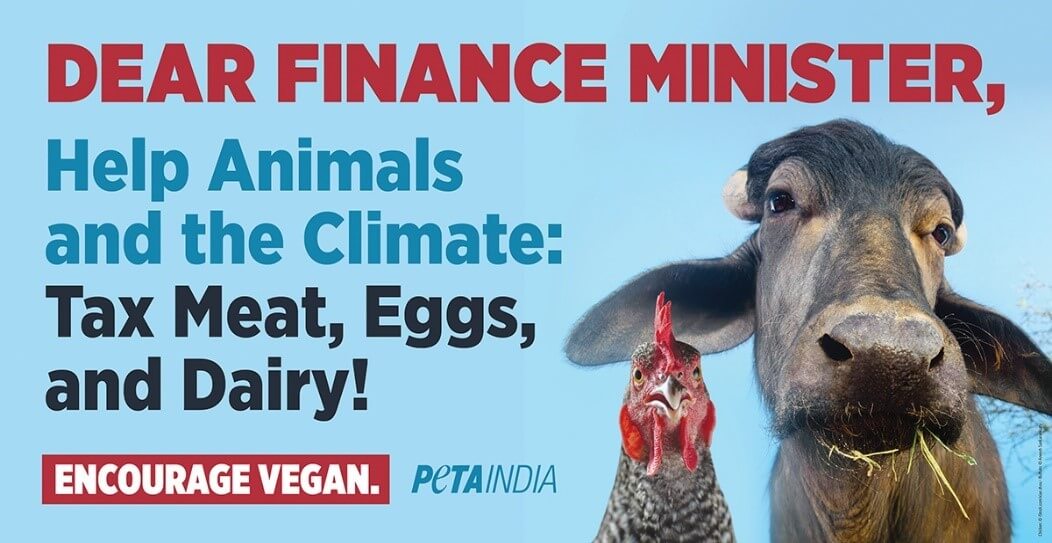
PETA India’s billboard is located at Rail Bhavan (next to the Press Club of India), Raisina Road, New Delhi, Delhi 110001.
“A substantial tax on meat, eggs, and dairy would discourage consumption, sparing countless animals a miserable existence, improving human health, and saving the planet from the damaging emissions produced by these industries,” says PETA India Manager of Vegan Projects Dr Kiran Ahuja. “PETA India is urging the government to impose a meaningful tax on animal-derived foods and to encourage everyone to eat vegan for everyone’s sake.”
Taxing animal-derived foods and other steps to reduce citizens’ intake of these foods is not unprecedented. Germany, the Netherlands, New Zealand, Spain, and Switzerland have all discussed or taken steps towards taxing meat, eggs, and/or dairy or considered financial initiatives to address emissions caused by their production. The New Zealand health ministry has also actively recommended its public to consume more vegan food, China has committed to reducing its meat consumption by 50%, and Germany’s former environment minister banned meat from government meetings and events. Meanwhile, Canada removed dairy recommendations from its food guide.
Everyone who goes vegan dramatically reduces their carbon footprint: researchers at the University of Oxford found that cutting out meat and dairy can reduce an individual’s carbon footprint from food by up to 73%, making it conceivably the single biggest way to reduce a person’s impact on the planet.
Going vegan also benefits human health. It helps combat the spread of COVID-19, SARS, swine flu, bird flu, and other diseases stemming from confining and killing animals for food, and the Academy of Nutrition and Dietetics says vegans are at reduced risk of dangerous health conditions, including heart disease, type-2 diabetes, hypertension, certain cancers, and obesity.
And of course, vegan meals help animals. As PETA India reveals in its video exposé “Glass Walls”, chickens killed for food are often shackled upside down before their throats are slit. Cows and buffaloes are crammed into vehicles in such large numbers that their bones often break before they’re dragged off to the slaughterhouse, and pigs are stabbed in the heart as they scream. On the decks of fishing boats, fish suffocate or are cut open while they’re still alive. Newborn male chicks are ground up, burned, or buried alive in the egg industry, while male calves in the dairy industry are commonly abandoned, left to starve, or killed since they cannot produce milk.
PETA India – whose motto reads, in part, that “animals are not ours to eat” and which opposes speciesism, a human-supremacist worldview – offers a free vegan starter kit on its website. For more information, please visit PETAIndia.com or follow the group on Twitter, Facebook, or Instagram.
#