

Three New Kolkata Horse-Cruelty FIRs, Indian Teen’s NYC Horse-Carriage Death Spur PETA India Appeal to West Bengal Chief Minister for Non-Animal Carriages
Following three new First Information Reports (FIRs) in Kolkata horse-cruelty cases and the recent death of 18-year-old Indian tourist Romanch Mahajan in a horse-carriage incident in New York City, PETA India has sent an urgent appeal to West Bengal Chief Minister Shri Suvendu Adhikari, calling on the new state government to replace horse-drawn tourist carriages in Kolkata with modern, heritage-style electric carriages.
PETA India notes that just as New York City’s new mayor, Zohran Mamdani, is now pushing for a ban on horse-drawn carriages following the fatal incident there, West Bengal’s new government has a timely opportunity to prevent further suffering and danger in Kolkata by ushering in a humane, safe, and forward-looking model of tourism.
In its letter, PETA India points out that Mumbai has already replaced horse-drawn tourist carriages with beautiful, mechanised alternatives that preserve the city’s heritage aesthetic while improving livelihoods, protecting public safety, and eliminating animal suffering. Ubo Ridez, the maker of Mumbai’s e-carriages, as well as several West Bengal–based electric vehicle manufacturers, have expressed willingness to manufacture or supply heritage-style e-carriages for Kolkata.
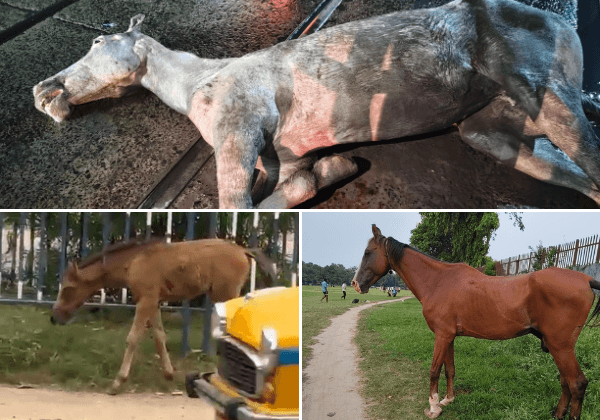
The appeal follows three recent incidents that reveal the danger and neglect inherent in Kolkata’s horse-carriage and “joyride” trade. On 10 June, a young foal was seen running frantically through active traffic in the Hastings area, putting both the animal and commuters at risk. On 15 June, another horse was found in Hastings, bloodied, debilitated, and suffering from a long-untreated hoof injury that had worsened over time. PETA India rescued the horse and transported him to a sanctuary for urgent veterinary care. On 21 June, a mare with a severe forelimb fracture was left lying in the middle of the busy Mayurbhanj and D.H. Road crossing in Ekbalpur, bleeding and unable to stand. She reportedly collapsed multiple times before dying amid traffic without any veterinary care.
FIRs have been registered in all three cases following PETA India’s intervention – two at Hastings Police Station and one at Ekbalpur Police Station – under relevant provisions of the Bharatiya Nyaya Sanhita, 2023, and the Prevention of Cruelty to Animals Act, 1960.
Horses used for rides and tourist carriages in and around Victoria Memorial are routinely found anaemic, malnourished, injured, overworked, or collapsed from being forced to haul heavy loads and work on hard road surfaces. Many are abandoned when they are injured, sick, or no longer profitable. Since 2024, at least sixteen horses in Kolkata have reportedly died or ultimately succumbed to road accidents and other injuries.
PETA India’s letter also warns that malnourished horses with poor immunity, kept in filthy and unhygienic conditions, are vulnerable to diseases such as glanders, which can be fatal to humans.
The Calcutta High Court has already taken serious note of the poor condition of horses in the city, the prevalence of unlicensed hackney carriages, inappropriate shelter for horses, and the abandonment of ailing and unfit animals on roads, where they create traffic hazards. In its order dated 9 May 2024, the court directed the state government to develop a proposal for rehabilitating horse owners and providing them with an alternative livelihood to hauling tourists in carriages so that “dispensing with the horse-drawn carriages as done in Mumbai can be considered and examined for its feasibility”.
PETA India has urged the West Bengal government to announce a time-bound prohibition on horse-drawn tourist carriages in Kolkata, introduce heritage-style e-carriages as a humane and sustainable replacement, rescue and rehabilitate the horses to appropriate sanctuaries, and crack down on the encroachment of public land for tethering horses.
Urge Kolkata to Replace Horse-Drawn Carriages with Cruelty-Free Electric Carriages