

Amid AI Concerns, PETA India Bengaluru Billboard Campaign Says Meat Industry is WORSE for the Environment & Animals
As Bengaluru gears up for Cypher AI Expo 2026 and World AI Summit and public concerns over the environmental footprint of AI infrastructure grow, PETA India has launched the first phase of a billboard campaign highlighting the far greater environmental and animal welfare costs of the meat, egg, and dairy industries, and encouraging passersby to go vegan. The campaign, being launched during World Vegetarian Month (October), carries a timely message: “THE BIGGEST RESOURCE DRAIN ISN’T AI. IT’S MEAT. PLEASE, GO VEGAN.” Beginning in Bengaluru, the campaign will expand to other AI-focused Indian cities.
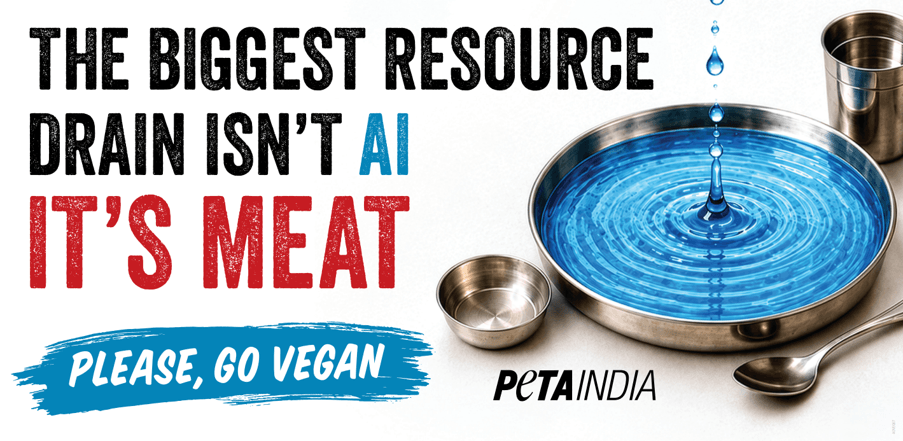
The difference in water use is stark: a peer-reviewed global analysis estimates that animal-derived food production withdraws around 566 billion cubic metres of water annually – more than 85 times the 6.6 billion cubic metres at the upper end of projected global AI water withdrawals for 2027. The animal agriculture figure comprises approximately 513 billion cubic metres for irrigating animal feed, 40 billion for animals’ drinking water, and 13 billion for water used for “livestock” facilities.
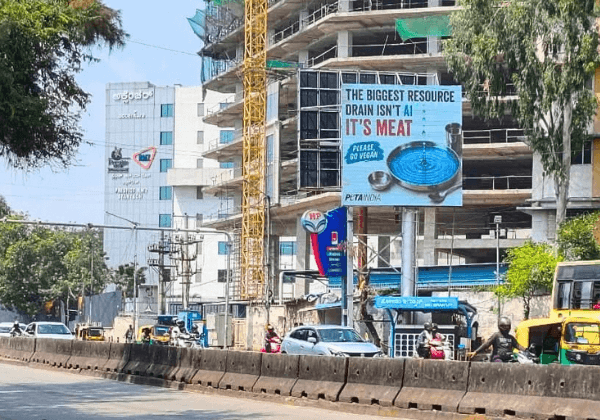
PETA India’s billboard is located at 1, Hosur Road, Santhosapuram, Koramangala Industrial Layout, Koramangala, Bengaluru, Karnataka 560029, India.
While growing attention has been paid to the water and energy demands of AI infrastructure, animal agriculture remains one of the planet’s most resource-intensive industries, consuming vast quantities of water and land and generating significant greenhouse gas emissions, all while subjecting billions of animals to immense suffering every year.
According to the United Nations, a global shift to vegan eating is essential to combat the worst effects of the climate catastrophe. Animal agriculture is responsible for roughly one-fifth of all human-induced greenhouse gas emissions. India’s cows and buffaloes alone account for 14% of global livestock emissions, mostly through methane. Research shows that going vegan can reduce an individual’s food-related carbon footprint by up to 73%, making it one of the most effective steps anyone can take as an individual to lessen their environmental impact.
India has influenced the world to be kind to animals and the environment through meat-free eating since 4th century BC. Today, India has the largest meat-free population in the world, while 10% of Indians identify as vegan. Everyone who goes vegan spares up to nearly 200 animals every year, dramatically reduces their carbon footprint, and lowers their risk of heart disease, diabetes, and certain cancers.