

PETA India Calls For Ban on Dogs Used for Fighting Following ‘Predictable’ Killing of Lucknow Woman by Pit Bull
For Immediate Release:
19 July 2022
Contact:
Hiraj Laljani; [email protected]
Monica Chopra; [email protected]
Lucknow – In response to the recent news that an elderly woman in Lucknow was mauled to death by her son’s pit bull, a tragedy among many occurring globally and causing countries and states to ban “bully” breeds, People for the Ethical Treatment of Animals (PETA) India has written to Minister of Fisheries, Animal Husbandry and Dairying Shri Parshottam Rupala calling for an urgent amendment to the Prevention of Cruelty to Animals (Dog Breeding and Marketing) Rules, 2017. PETA India is seeking change to prohibit the keeping and breeding of foreign dogs bred for fighting and aggression, such as pit bulls, as well as dogs bred for illegal racing contests and brachycephalic dog breeds. Brachycephalic dogs, such as pugs, suffer from breathing difficulties that often require corrective surgery. PETA India seeks legal amendments designed to safeguard these breeds from such cruel exploitation.
Dr Manilal Valliyate, veterinarian and CEO of PETA India, says, “Dogs are suffering for cruel human exploits such as criminal dogfighting and illegal racing and because many people treat them like toys rather than living, feeling beings. A prohibition on all breeds used for unlawful fighting and racing and those with breathing difficulties would protect these dogs from being born only to face cruelty and suffering.”
In India, inciting dogs to fight is illegal under the Prevention of Cruelty to Animals (PCA) Act, 1960. Yet organised dogfights are prevalent in Punjab, Haryana, and other parts of north India, making pit bull—type dogs used in these fights the most abused dog breeds. They’re commonly bred to be used in illegal fighting or kept on heavy chains as attack dogs, resulting in a lifetime of suffering. Many endure painful physical mutilations such as ear-cropping – an illegal process that involves removing part of a dog’s ears to prevent another dog in a fight from grabbing their ears, thereby losing the fight. In a fight, the dogs are encouraged to continue until both dogs become exhausted and at least one is seriously injured or dies.
The Animal Welfare Board of India (AWBI) – the statutory body established under Section 4 of the PCA Act, 1960 – states that greyhound races commonly held in Punjab are illegal. In a letter addressed to the chief secretary of the government of Punjab, dated 11 November 2014, the AWBI advised that greyhound and other dog races should be stopped in the state – yet they continue. Dogs used for racing are commonly confined to small, barren kennels and denied adequate veterinary care, and they frequently sustain painful and often lethal injuries, such as broken backs and legs. Uncompetitive dogs and those who slow with age are often abandoned by the time they are three. Commercial dog racing does not occur or is prohibited in most countries.
Meanwhile, foreign brachycephalic dogs such as pugs, popularised in India by the Vodafone commercials, are known to suffer severe respiratory problems such as brachycephalic obstructive airway syndrome (BOAS) and eye and skin disorders. Pugs and other brachycephalic dogs such as Pekingese, shih tzu, and lhasa apsos are also predisposed to proptosis due to their shallow eye orbits – a condition in which the eye bulges out of its socket and that requires emergency surgery. Cavalier King Charles spaniels, also a brachycephalic breed, suffer from syringomyelia, a condition in which a dog’s skull is too small for their brain as they are bred for an unnaturally small head.
In the UK, it is against the law to keep pit bull terriers, Japanese Tosas, Dogo Argentinos, and Fila Brasileiros – breeds banned because they are traditionally used for illegal dogfighting, bred and trained for aggression, and commonly abused. Similarly, in Australia, those breeds prohibited in the UK as well as Perro de Presa Canarios are restricted breeds, and in Germany, pit bull terriers, American Staffordshire terriers, and Staffordshire bull terriers cannot be imported.
Now, there are calls in the UK and elsewhere to ban flat-faced breeds such as French bulldogs and pugs considering the severe health problems they face. In Norway, the selective breeding of British bulldogs and Cavalier King Charles spaniels is banned for the same reason. The Oslo District Court has acknowledged that breeding for certain physical traits is cruel and results in “man-made health problems” for dogs such as difficulty breathing.
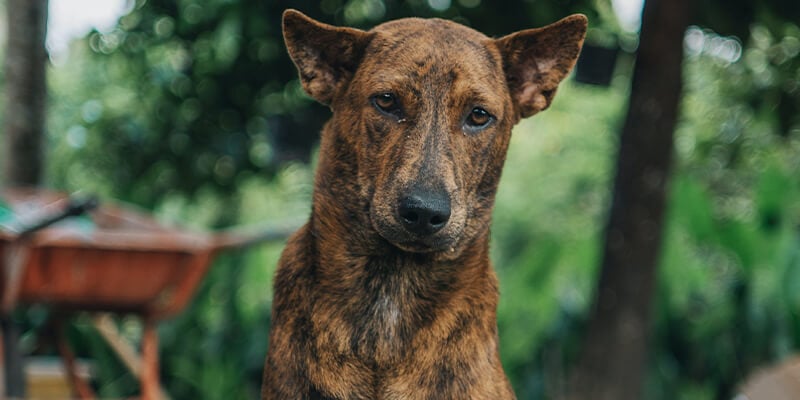
“Pedigree” dogs sold in pet shops and by breeders – apart from commonly facing health issues – are typically deprived of proper veterinary care and adequate food, exercise, affection, and opportunities for socialisation. In contrast, Indian community dogs, available for adoption at shelters and on the street, are healthier and more robust because they are not deliberately bred for abnormal physical traits from a small gene pool.
PETA India – whose motto reads, in part, that “animals are not ours to abuse in any way” – opposes speciesism, a human-supremacist worldview. For more information, please visit PETAIndia.com or follow the group on Twitter, Facebook, or Instagram.
#