
Chicks Crushed, Drowned, and Burned to Death by Egg Hatcheries
You've never seen anything like this before – this is where your eggs and chicken meat are coming from!
An investigator from Anonymous for Animal Rights (now called Animals Now) visited major hatcheries and farms involved in the meat and egg industries.
Incubator problems caused some chicks to hatch with organ deformities and other health complications, and rough methods of determining chicks’ sex often caused them distress. Because hens peck each other out of frustration caused by the severe confinement of a battery cage, in which they cannot even spread a wing, workers cut off portions of newly hatched female chicks’ beaks with burning-hot blades.
Cruelty Begins Before They're Even Hatched
Instead of allowing mother hens to sit on their eggs, broiler and layer farms use mechanical incubators to hatch chicks in bulk. According to the general manager of Venkateshwara’s layer hatchery, a single incubator can hold up to 90,000 eggs. At Diamond Group’s broiler farm, each incubator crate holds up to 180 eggs. When the chicks hatch, they can be extremely crowded – even to the point of being crushed. Sometimes they are pecked at by other chicks who have hatched.
Relying on machines to do nature’s work invites problems: at SR Group’s broiler hatchery, problems with the machines caused some chicks’ organs to protrude from their bodies.
A Painful 'Welcome' Into the World
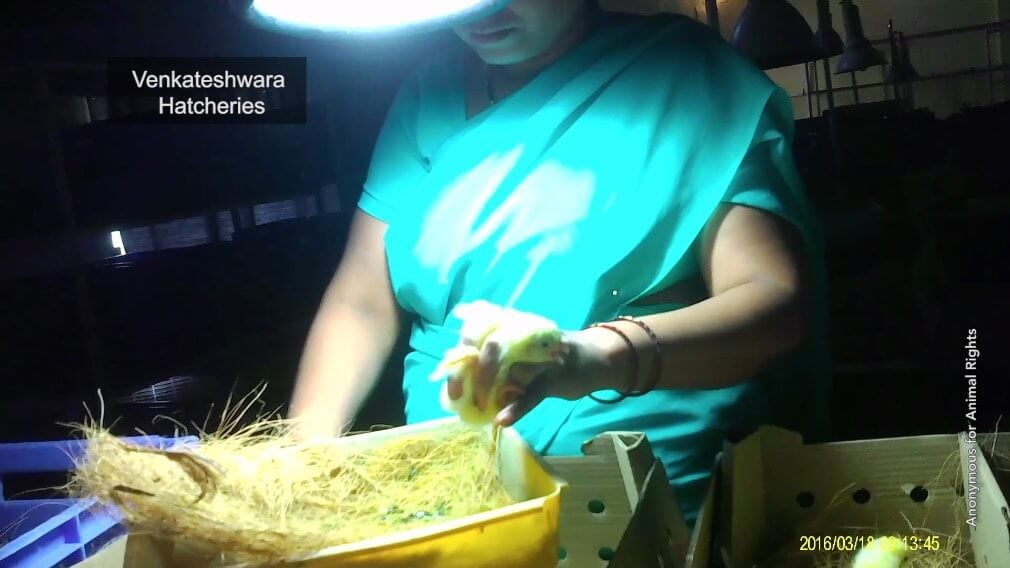
Shortly after birth, both male and female chicks are “sexed”, or separated by sex. In this usually distressing procedure, workers handle chicks roughly and press forcefully on their sensitive genitals. At Venkateshwara’s layer hatchery, the investigator saw workers using the “vent sexing” method, in which they squeeze out the chicks’ faeces and then spread open their cloacas in order to determine their sex. Suguna Foods’ broiler hatchery also conducts sexing, although via a different method, because apparently male chicks grow faster.
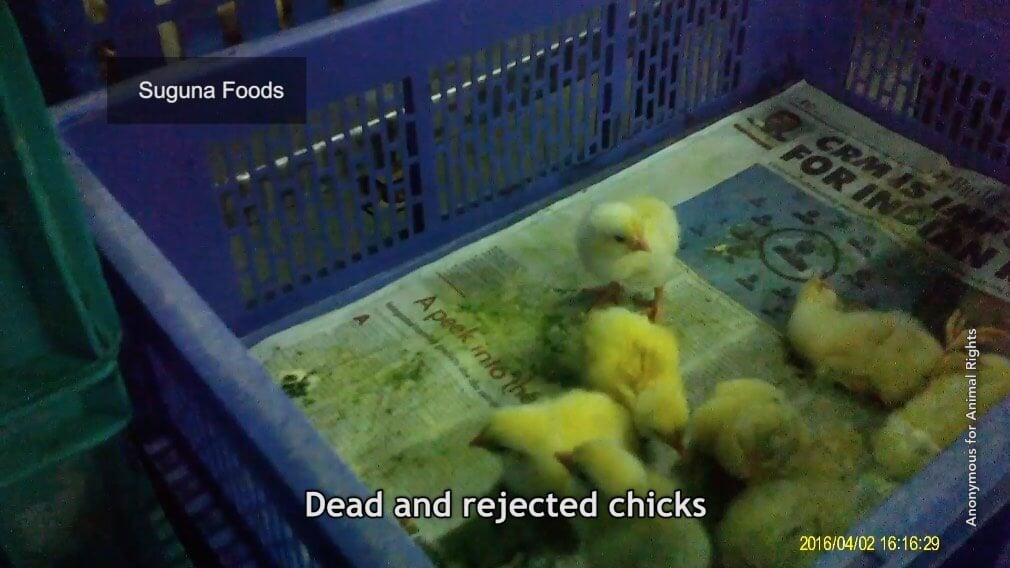
Workers check for healthy and unhealthy chicks, which is known as “grading”. At a Venkateshwara hatchery, the investigator was told that 5% to 10% of chicks are graded as “poor quality”. Rejected chicks may be kept and sold for a cheaper price, but more often than not, they are killed . Suguna Foods’ broiler hatchery also apparently rejects 5% to 10% of newly hatched chicks for reasons that include hatching too early or too late, lameness, organ deformities, and general weakness. Live and dead rejected chicks are thrown into the same crates. Some live chicks desperately peck at other chicks’ carcasses, and some are discarded while still trying to hatch.
Despicable Debeaking
When chicks have only been alive for a few days, farmers cut off a large portion of their beaks with a searing-hot blade – no painkillers are administered during this excruciating procedure. This is called “debeaking”, and it is intended to prevent chicks from hurting each other when they lash out in frustration caused by their intense confinement. But many chicks die of shock from the pain, and some die of starvation when it makes eating too painful.
Diamond Group uses a machine to debeak chicks who will be used for breeding on broiler farms eight or nine days after they hatch. A worker sits in front of the machine, picks up chicks one by one, and holds their beaks up to the burning-hot blade. Many birds defecate in distress during this procedure and cry out in fear and pain.
Gruesome Killing Methods: Drowning, Burning, Crushing, Suffocating, and Grinding
Diamond Group frequently kills newly hatched chicks by drowning them. The investigator saw chicks desperately trying to climb on top of each other and up the sides of barrels as workers poured soapy water over them. According to one employee, it takes up to 30 minutes for the chicks to die this way.
Another killing method is burning. The manager at Diamond Group told the eyewitness that burning the chicks is a slow process. Some who have already survived the attempt to drown them go on to survive being set on fire and are therefore burned a second time, a process that takes place over the course of two days. Burning chicks try to walk and struggle to breathe as the flames engulf them . SR Group’s broiler hatchery also burns chicks to death: the investigator saw burned chicks trying to escape and hide from the workers who were catching them and throwing them back into the fire.
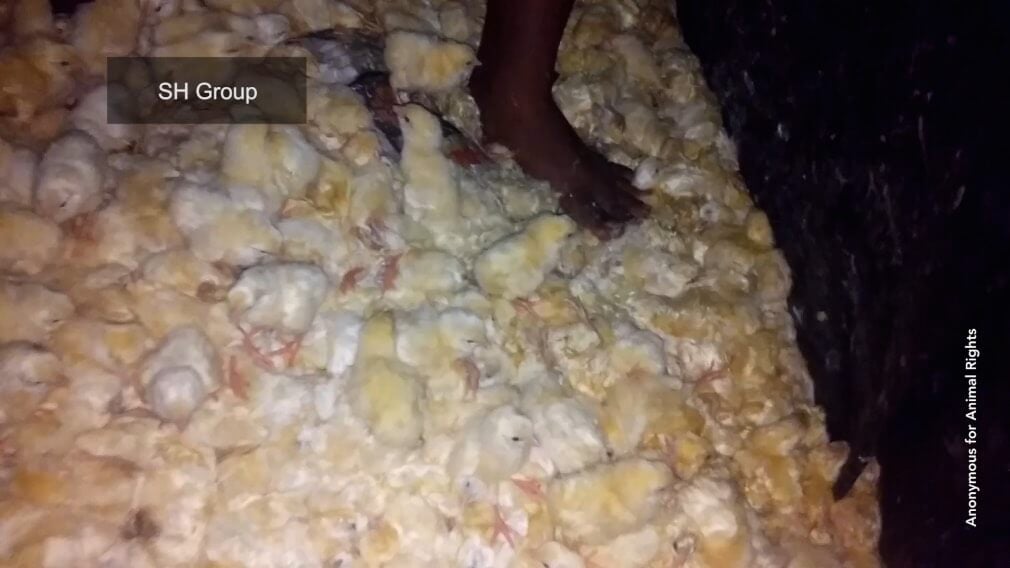
When workers load and unload chicks onto and off trucks, they often step on them, crushing them to death. At SH Group’s layer hatchery, workers could be seen walking on the fragile baby birds while unloading drums full of others. The chicks at the bottom of these drums are crushed or suffocated, and workers carelessly smashed chicks between drums when stacking them or while rolling them. The investigator saw chicks so crushed that their organs were protruding from their bodies, which a worker said happens daily.
Sometimes smashed chicks were simply tossed into the waste bin while still alive. But at Suguna Foods’ broiler hatchery, workers dump live rejected chicks – some active and seemingly healthy, others injured, suffering from prolapsed organs, or only partially hatched – into large grinders along with dead chickens and egg shells. Their ground-up remains are turned into food for other animals.
Baby Chicks Sold as Fish Food
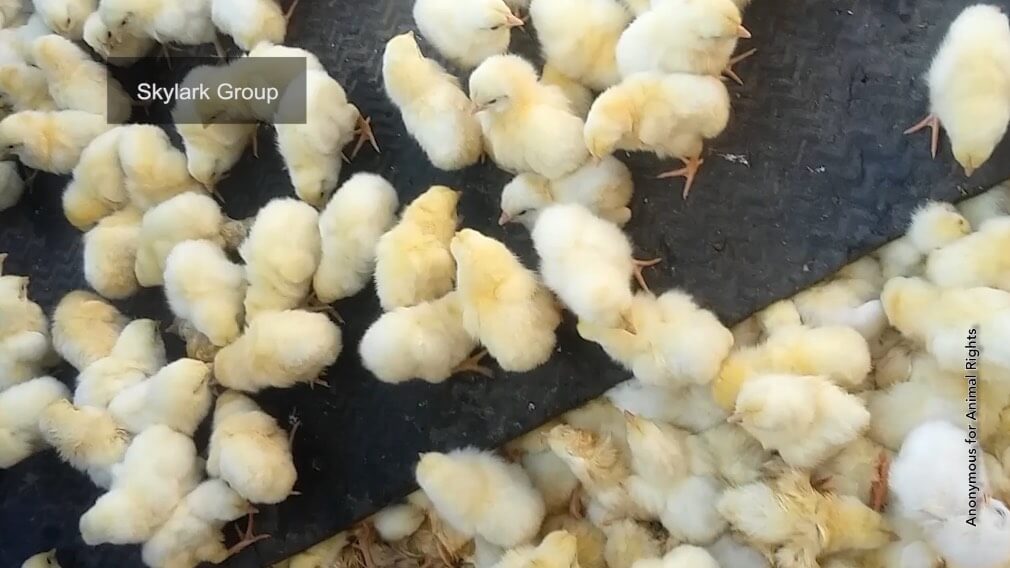
Many of the rejected chicks are sold to fish farms as food. Skylark’s broiler hatchery does this, according to a transporter and, to that end, carelessly loads thousands of starving newly hatched chicks – who are never fed and who peck at each other out of sheer desperation – into trucks for transport.
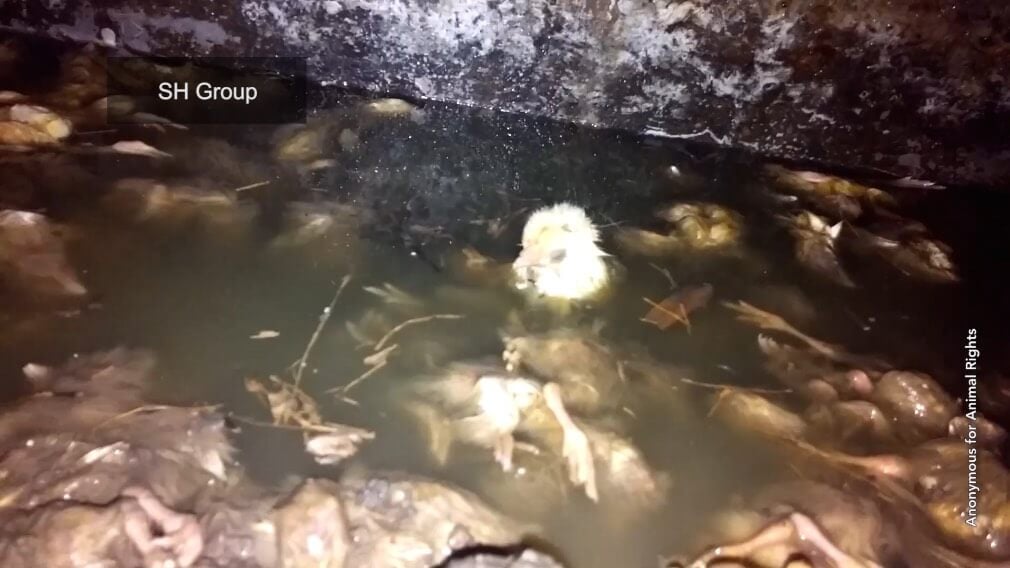
Trucks that have picked up chicks from SH Group pull right up to the water, and workers throw the chicks – whether living, dying, or dead – directly into fish tanks to drown or be eaten alive by fish. Terrified chicks try to escape and hide under rocks, but workers kick them into the water, and soon their feet are covered with chicks’ body parts and feathers. SH Group alone apparently hatches and kills about 5 million male chicks each month.
You Can Help Stop This!
It is illegal to kill any animal, other than for reasons permitted under the law, which includes killing an animal for food after stunning them to render them unconscious, euthanising a suffering animal when it would be cruel to keep such an animal alive, or euthanising animals for disease control purposes. The crude killing of male chicks is a cognisable offence punishable under Section 11(1)(l) of The Prevention of Cruelty to Animals (PCA) Act, 1960, along with Section 428 or 429 of the Indian Penal Code, 1860. Further, causing unnecessary suffering to animals violates Section 3 and 11(1)(a) of the PCA Act, 1960.
Following an appeal from PETA India, the governments of Andhra Pradesh, Gujarat, Haryana, Jammu, Kerala, Madhya Pradesh, Maharashtra, Rajasthan, Uttarakhand, and Uttar Pradesh have issued orders against gruesome and illegal chick-killing practices. The Assam, Bihar, Chhattisgarh, and Goa governments have additionally committed to adopting in ovo sex-determination technology, when it becomes commercially available- which would identify eggs with male embryos at an early stage in their development, thereby helping to prevent their birth and altogether stopping the illegal killing of male chicks.
Appeal
Dear Officials:
Video evidence from Indian poultry hatcheries shows that unwanted male chicks (because they cannot lay eggs) are illegally killed using gruesome methods such as drowning, burning, and crushing. Such crude killing of chicks is a cognisable offence punishable under Section 11(1)(l) of The Prevention of Cruelty to Animals (PCA) Act, 1960, along with Section 428 or 429 of the Indian Penal Code (IPC), 1860.
The governments of Andhra Pradesh, Gujarat, Haryana, Jammu, Kerala, Madhya Pradesh, Maharashtra, Rajasthan, Uttarakhand, and Uttar Pradesh have issued orders directing the end of these gruesome and illegal chick-killing practices. Meanwhile, the governments of Assam, Bihar, Chhattisgarh, and Goa have additionally committed to adopting in ovo sex-determination technology as soon as it becomes commercially available. This would identify eggs with male embryos at an early stage in their development, thereby helping to prevent their birth and altogether stopping the illegal killing of male chicks.
In ovo sex-determination is a wonderful scientific breakthrough which has the power to end the illegal killing of male chicks by the egg industry. It is imperative for birds’ welfare for India to take advantage of this technology and prevent the killing of unwanted male chicks in the most grisly manner. France and Germany are among nations that have already taken steps to outlaw the mass killing of male chicks.
I therefore urge you to use your authority to safeguard male chicks from illegal, painful, and cruel deaths by taking the following action:
- Enforcing the existing laws – Section 11(1)(l) of the PCA Act, 1960, and Sections 428 or 429 of the IPC, 1860 – as per which the killing of male chicks is a punishable offence, against which a first information report must be registered
- Making in ovo sexing technology commercially available either by importing the technology or by collaborating with the companies engaged in the said technology to develop an indigenous version
Thank you for your consideration.
Sincerely,
[Name]
