
Leather
Leather Is Dead Skin
Buying leather directly supports the misery of the slaughterhouse. According to statistics from the Ministry of Food Processing Industries and the Council for Leather Exports, the value of leather exports from India – which is one of the largest leather manufacturers in the world – is 10 times greater than the value of its meat exports. So clearly cows and other cattle are suffering and being cruelly slaughtered so that the leather industry can profit from their skins.
 Believe it or not, India’s treatment of cows is among the cruellest in the world. Since it is illegal to kill healthy, young cattle in India, they are often deliberately maimed. Their legs may be broken, or they may be poisoned so that they can be declared fit for slaughter – not that many slaughterhouse workers care about the letter of the law. We have seen healthy calves as well as cows who were still able to produce milk being killed openly.
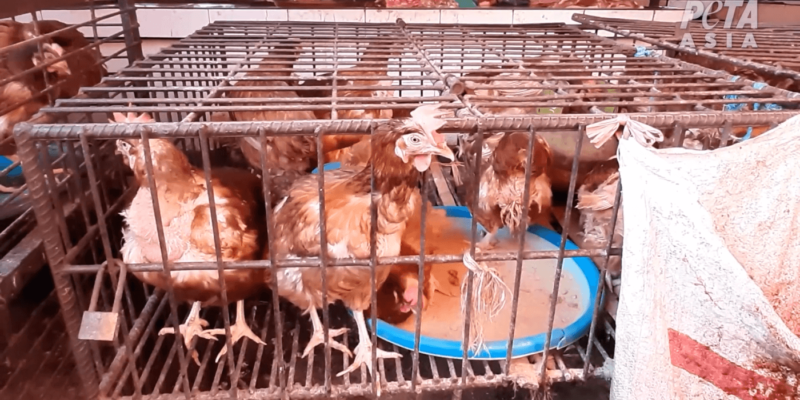
Cattle are tied together with ropes that are run through their noses, and they are beaten mercilessly during forced “death marches” over hundreds of kilometres. They are also transported in appalling conditions after being crammed on top of each other into lorries in the searing Indian heat. During transport, they cannot help but crush one another, and they die hideous deaths as a result of suffocation and injuries. The lorries careen at breakneck speeds along bumpy dirt and gravel roads and down mountain passes, pitching the cows around and causing more injuries and deaths.
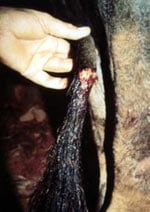
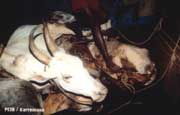 During the marches, cattle collapse from hunger, exhaustion, injury and despair. Handlers force them along by breaking their tails at each joint and rubbing tobacco, chillies and salt into their eyes. Each time a cow’s tail is broken, the pain is similar to what we would feel if we broke a finger. They are never offered food or even so much as a drop of water.
By the time they arrive at the slaughterhouse, some animals are dead, and many are so sick and injured that workers must drag them inside – again without considering their feelings or the suffering they are forced to endure. The animals’ short fur stands on end, and if one looks closely, one can see the terror and feeling of betrayal in their eyes. Once inside, their throats are cut in full view of other cattle, who are forced to watch and wait. Some have their legs hacked off while they’re still conscious, and some endure the agony of being skinned alive. Workers often kill pigs by forcing iron rods through their bodies.
“While the cows were being loaded, I could hear the gurgling of one cow choking on her own blood. The rope in her nose had been improperly placed, and with the constant tugging on it by rough handlers, as well as being tethered to her fellow cattle during the 12-hour march, it had ripped through her nose, and blood was pouring down her face.”
– PETA India investigator
The Role of the Dairy Industry
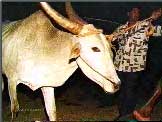 A common source of hide for ahinsak footwear is the dairy industry! Since male calves are of no use to dairy farmers, some are sold for slaughter, while others are intentionally starved to death so that their skin can be sold to ahinsak manufacturers.
Not only is the dairy industry cruel, it also contributes to human diseases.
Indeed, it’s clear that milk is not a health food:
- Milk is now linked to Crohn’s disease, which affects hundreds of thousands of people. The main symptoms include fatigue, urgent diarrhoea and weight loss. The disease also causes inflammation, deep ulcers and intestinal scarring.
- Dairy products can also contribute to heart disease, certain types of cancer, diabetes, allergies, asthma and osteoporosis. Many knowledgeable doctors and nutritionists are speaking out against dairy consumption. World-renowned health expert Dr John McDougall calls milk “liquid meat” because he believes that it is just as unhealthy as animal flesh. The late Dr Benjamin Spock, America’s leading authority on child care, said that human infants should never drink animal milk because it can contribute to anaemia, allergies and insulin-dependent diabetes.
Cattle Are Not the Only Animals Killed for Their Skins
While most leather products are made from the skins of cattle and calves, leather is also made from the skins of horses, sheep, lambs, goats and pigs who are slaughtered for meat. Many of these animals suffer the horrors of severe crowding, unanaesthetised castration, branding, tail-docking and dehorning. Other species – including zebras, bison, boars, deer, kangaroos, elephants, eels, sharks, dolphins, seals, walruses, frogs, crocodiles, lizards and snakes – are hunted and killed specifically for their skins. Rats, cats and stray dogs are also killed for their skins, but since people are typically reluctant to purchase products made from these animals, their skins are often labelled simply as “leather”. A lot of the leather that comes from wildlife – such as crocodiles – is actually made from endangered, illegally poached animals. When you buy leather, you can’t be sure what kind of animal it came from.
Exotic animals such as alligators are factory-farmed for their skins. On alligator ranches, up to 600 animals can be kept in a single tiny building. The buildings reek of rancid meat, alligator waste and stagnant water. Although alligators in nature sometimes live to be 60 years old, on farms they are usually butchered before the age of 4.
Alligators on farms are often beaten with hammers and sometimes take up to two hours to die. Snakes and lizards are often skinned alive because of the widespread belief that live flaying makes the leather manufactured from their skins more supple. Kid goats are sometimes boiled alive to make gloves, and the skins of unborn calves and lambs – some of whom are purposely aborted, some of whom come from slaughtered pregnant cows and ewes – are considered especially “luxurious”.
According to recent international media reports, in one province in Thailand, dogs are rounded up and more than 50 of them are confined at once to a single lorry for five days without food or water, only to become briefcases, car-seat covers, trimmings on a fancy coat or fancy rawhide chews for other dogs.
Consumers are usually unaware of these products’ origin because these items are often mislabelled as “lamb”, “calf” or “goatskin”. Nevertheless, it is not illegal to sell or import dog fur, even in the European Union.
“At Deonar abattoir in Mumbai, sheep, goats and cattle arrive in overcrowded and bone-cracking conditions, and are made to suffer, strewn across the grounds, with their injuries untreated, until they are purchased for slaughter or until they die. These animals are forced to watch their companions be killed before they themselves have their souls cut out of their bodies.”
– PETA India investigator
Environmental Effects of Leather
Leather factories wreak havoc on the environment. The leather tanneries around the Ganges have been cited for dumping toxic metals such as chromium into the river. All waste that contains chromium is considered hazardous. Tannery effluent also contains large amounts of other pollutants, such as protein, hair, salt, lime, sludge, sulphides and acids. Groundwater near tanneries has been found to contain highly elevated levels of lead, cyanide and formaldehyde.
People who work in and live near tanneries are dying of illnesses caused by constant exposure to toxic chemicals. Pollution such as the kind dumped into the Ganges by leather tanneries has been cited as a major cause of disease outbreaks and has also been implicated in the deaths of marine animals. The US Centers for Disease Control and Prevention found that the incidence of leukaemia among residents near one tannery was five times the US average.
According to Fair TradeMark Canada, many rivers in India are poisoned by tannery wastes. The group states that in the region around the Palar River, 35,000 hectares of farmland have been affected by tannery waste. Waste has reduced the yield of the once-fertile land by half. Farmers often receive no compensation for crop losses. As a result, many of them are forced to give up farming and sell their land to tanneries. In the local population, there has been a significant increase in the incidence of health problems which result from drinking water polluted by tannery effluent. These conditions include gastrointestinal diseases, asthma, growth abnormalities in children and a type of diarrhoea that affects infants and is caused by poisoned breast milk. The local population has also become more susceptible to tuberculosis. The tannery workers themselves suffer from skin diseases, fever, eye inflammation, lung cancer and sterility. Also, according to Fair TradeMark Canada, when one NGO tested soil and water samples from 13 affected villages for tannery chemicals, in nearly every case, the values exceeded the limits allowed by Indian law. Villages that were once renowned for their cultivation of aubergines and flowers now produce neither.
Environmentalists and Citizens Protest Tannery Toxins
Environmental activists and villagers in Kanpur, home of the largest tanneries in India, recently banded together and blocked a tannery drain that releases toxic effluent into the Ganges.
The action was prompted by the fact that effluent from leather tanneries, despite being polluted with chromium and other chemicals used in the tanning process, was being promoted as “treated” and safe for irrigating farmland. But the polluted water has laid waste to crops and is rendering the soil infertile.
Villagers who are exposed to this water complain of itching, raw skin, numbness and paralysis. Livestock who drink the water are also suffering adverse effects. Environmentalists fear that the toxins from the tannery effluent are being passed through the food chain and report that some villagers are already showing signs of poisoning.
Leather Alternatives
It’s easy to find high-quality, cruelty-free shoes and accessories that are stylish and inexpensive. Just about anywhere you shop, you can find a wide selection of non-leather jackets, shoes and accessories made from materials such as cotton, linen, ramie, jute, canvas and synthetics. Top designers are also using spun glass, polyvinyl chloride and pleather.