

Caged Birds Have Nothing to Sing About

Of all the animals people keep in their homes, birds are the most unwilling companions. In the wild, birds live in flocks and talk to each other using hundreds of different calls, including hushed chatter and whispers that we cannot even hear. They even politely take turns, letting other birds talk. They love engaging in social activities such as taking sand baths, playing hide-and-seek, dancing, building nests with their mates and nurturing their young. One birdwatcher has also seen birds climb up a snow bank, slide down and then climb up again to amuse themselves!
When captured and put into cages, these same fun-loving birds become depressed and withdrawn. They often overpreen themselves to the point of mutilation. Some people force birds to endure painful wing-clipping so that the animals cannot fly away, yet flying is as natural and important to birds as walking is to us.
Birds are remarkably adept at finding their way across the sky. Birds such as geese migrate across vast areas to warmer climates by using air currents to hold them aloft and by using the sun, stars, landmarks and even the Earth’s electromagnetic field to find their way.
Birds are also deeply attached to their mates. Many species of geese, albatrosses, penguins and pigeons are monogamous, and these birds have been seen grieving the death of their mates. They also tend to take longer to find a new mate than other animals do. Considering the bonds that they build when taking turns incubating eggs, feeding their young, teaching their young to fly and building nests, this is not surprising. A coucal (a member of the cuckoo family) was once spotted trying to desperately revive his dead mate.
Birds’ loyalty often extends to their flockmates and sometimes even to their rivals. For instance, one robin, after crippling another robin in a fight, was seen feeding his rival to keep him alive.
Domestic birds are also extraordinary animals. Studies by Dr Chris Evans, an animal behaviourist at the UK’s Bristol University, show that chickens are as smart as small children. They can learn to use switches and levers to control the temperature of their surroundings and can even open doors leading to feeding areas.
Not for a Lark
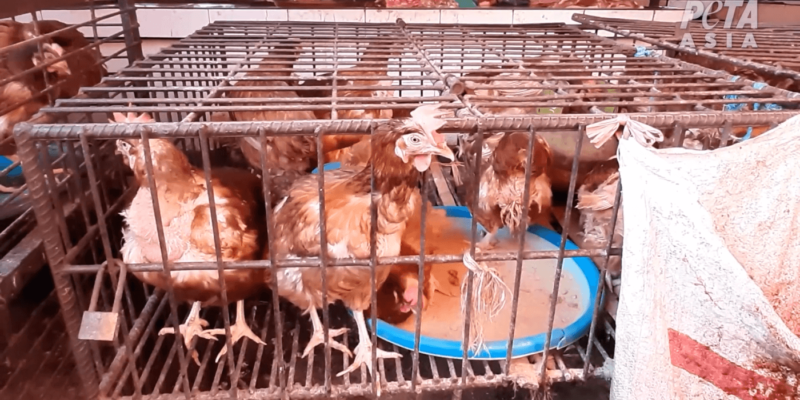
Not only is keeping these intelligent and sensitive animals in cages cruel, it is also illegal. The Wildlife Protection Act of 1972 and the amendment added to it in 1991 ban the capture and trade of all 1,200 varieties of indigenous birds found in India. However, in spite of this, 300 species of birds are openly sold in town and city markets. Muniyas, mynas and parrots are among the birds most commonly found in these markets, but it is not unusual to find owls, hawks, peacocks and parakeets for sale as well. The Convention on International Trade in Endangered Species restricts the trade of foreign birds, but most markets still have foreign birds such as Australian lovebirds, African parrots and finches for sale.
Most indigenous birds are captured in the hilly and forested areas of north and northeastern India. They are caught in the most horrifying ways, crammed into boxes and then transported across cities. The birds reach their destination wounded, frightened and starved, if not dead. For every bird who makes his way to the market, two die on the way.
To catch birds, trappers use cruel, ancient methods that have been passed down for generations. For instance, they use a substance called bird lime which is made from slaked lime and the sap of the peepal tree. The substance is used to capture birds by getting them to stick to a pole.
People also take fledglings out of their nests and then hand-feed them. Other methods are far more hazardous. For instance, some people use mist nets, which snare all birds who fly into them. The struggling birds often suffer serious injuries.
You Can Help
The best way to stop this cruel trade is never to buy birds and to discourage others from buying them. If you want an animal companion, go to your nearest animal shelter and adopt a dog, cat or other animal. If you know anyone who has a caged bird, tell him or her how cruel caging birds is. Never, ever set a bird free on your own. Birds who have been imprisoned for a long time do not know how to defend themselves in nature, and they may not even be capable of flying. Contact your local wildlife authorities and ask them to direct you to the nearest rehabilitation centre.
Also, write to the chief wildlife warden in your state if you know of any black markets that are dealing in protected species of birds or other animals.